Digital Streetz — Directing Brand & Product
Director of Brand & Product — Marketing, design, AI and development — 2024–present
📣 Context
Digital Streetz became over the years a studio that takes on commissioned and consultancy work, and today it brings marketing, design, AI and development into one team.
The challenge for brand and product was to make four practices read as one offer, keep the quality consistent across very different clients and projects, and show it all through the studio's own website.
🏆 The Studio Today
🥋 My Role
As Director of Brand & Product, I lead brand and product for the studio and its clients, and direct projects from first brief to launch: brand and art direction, product design, design systems and front-end build. I scale the team to the project, bringing in three or four extra designers when a project needs them, and work directly with client leadership; at AllRisk, with the founders, CEO and CFO.
🤖 AI & Automation
AI is one of the studio's four practices: self-hosted models and RAG, agents and automation, and generative image and video with ComfyUI. The approach is the same on every project: start from a task that eats hours and from data that already exists, not from a technology looking for a use, then pick the model that serves the task.
- A second mind, not a replacement. In the studio's own work, AI sits beside the team for fast brainstorming of ideas, concepts, products and code, with Claude Code, opencode, Cline, Claude Design, Google Stitch and local models through Ollama, vLLM and llama.cpp. People make the decisions and do the checks.
- Data stays with the client. Open-source models run on the client's servers or the studio's, without sending data to third-party services.
- Answers show their source. With RAG, the answer cites where it came from and respects each person's permissions.
- In production: at musica.com.pt, Redação structures every press release but never writes the article, and has cut the time to produce an article from hours to under an hour; at AllRisk, an assistant answers from the broker's PDF documents and SeguroIA identifies mandatory insurance by activity.
🧭 Key Decisions
- Four practices, one offer. Consulting & Outsourcing, Marketing & Design, AI & Automation, and Development & DevOps are presented and sold as one team, so a client gets brand, product and engineering in the same conversation.
- Scale the team to the project. The team grows and shrinks with the work, from 10 to 15 people, with outside designers brought in when a project calls for it.
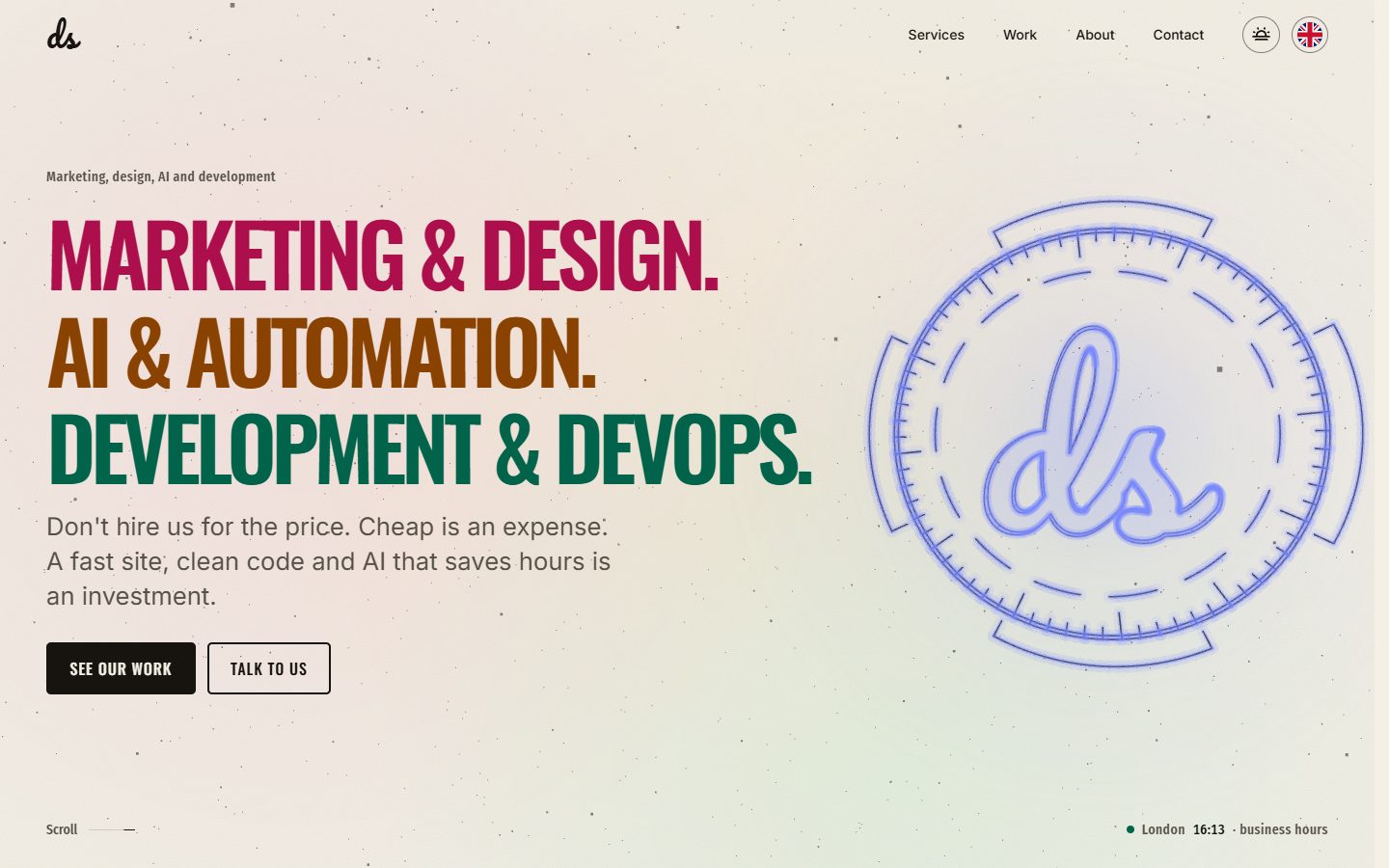
- The studio's own site behaves like what it sells. Fast, accessible and easy to maintain: four languages, light and dark themes, and no build step.
🖼️ The Studio Website
The website runs on a small set of design tokens for colour, type and spacing, shared by the home, the practice pages, the service pages and the case studies. Contrast for both themes is calculated from the tokens by a script, so an accessible palette is checked rather than assumed.
- English, Spanish, Ukrainian and Portuguese from day one, each with its own URL and no cookies to ask permission for; a script validates every translation.
- Light and dark themes with no flash on load; left on automatic, the theme follows sunrise and sunset.
- A 3D wireframe version of the logo as the main object on the page, with a plain fallback if anything fails.
- One icon set (Phosphor) and self-hosted typefaces covering Latin and Cyrillic, checked against the copy in every language.
📌 Selected Studio Work
- AllRisk — an insurance website built around a risk slider, with AI that answers from the broker's own documents.
- Musica.com.pt — a music newspaper grown to 55k+ monthly visitors in under a year, and its AI newsroom tools.
- digitalstreetz.com — the live site.
🧠 Takeaways
- A studio's own site is its first case study. If it is slow, inaccessible or hard to maintain, nothing else on it is believable.
- AI is a practice, not a feature. It earns its place by saving hours on a real task, with the client's data and a source you can check.